Located in a valley stretching from the mountains of the south to the shores of the lake, Managua is the capital, a great capital, the administrative and political center of the country. It’s a city with a personality all its own, with a special atmosphere, where history has left its mark. Natural disasters too.
Two earthquakes, the first at the beginning of the 20th century and the second in 1972, gave visitors the impression of a hot urban mess. Strictly speaking, there is no downtown or old town. You’ll come across a few old buildings and an old cathedral as you make your way through the city. It’s a veritable architectural chaos, with modern residences and condominiums, shopping malls, but also real Latino barrios, rustic local stalls, bus terminals and large markets.
Managua is home to the largest market in Central America. El oriental. Hectares of stalls, stores and tiendas spread out and offer you de todo…It’s easy to get lost in this megalopolis, with few signs and many roundabouts, but there are always pleasant surprises after a traffic light: a mausoleum for the martyrs of the revolution or an old cathedral. Managua has its secrets, and it takes time to discover them.

Geography of the capital
A green capital
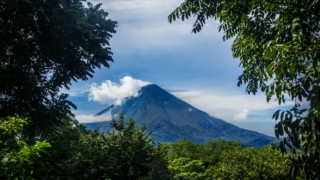
Managua is located in a valley close to the shores of Lake Xolotlán in the north. Barely a hundred meters above sea level, Managua, with its 540 km2 of urban area and 1.3 million inhabitants, is a very green city. Few tall buildings, a characteristic of the aftermath of earthquakes, Managua is characterized by its vastness and its surrounding hills, green valleys called las sierras de Managua, where it is cooler than in the sweltering center, averaging 27.5°C.

The importance of lakes
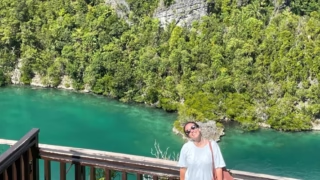
From Nahuati, an ancient local dialect, Managua would mean “where there is a body of water”. Lake Xolotlán or Lake Managua is certainly of considerable importance.Adjacent to Lake Nicaragua, Lake Managua embellishes the city, giving it a fresh, seaside feel, and some of its banks have been landscaped to facilitate the development of Nicaragua’s new tourist industry.

Rapid growth of Managua
Managua’s growth has been rapid since national independence, with banks and other international franchises springing up rapidly in its neighborhoods. The competition between Granada and León for the country’s capital also played its part, with the failure of either side to win propelled the city of Managua to the center of the country. As proof of this, there are no so-called colonial quarters or old town. Not only because of natural disasters, but also because of the absence of Spanish conquistadores during their discovery of the Indies. Instead, the region was home to a homogeneous mix of indigenous tribes, of which little or nothing remains.
A city without colonial traces
Unlike many Central American capitals, Managua contains few remnants of its colonial past. The indigenous peoples who originally inhabited this region were gradually integrated into the mestizo population that emerged following European contact, leaving limited archaeological evidence of pre-Columbian settlement within the modern city limits. While some historical sites preserve modest artifacts and traces of earlier inhabitants, Managua’s development—particularly after devastating earthquakes in 1931 and 1972—has largely obscured its pre-colonial heritage.


The Lagunas of Managua
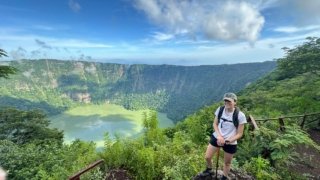
As you drive out and through Managua, you’ll be pleasantly surprised by the number of lakes you come across, many of them small crater lakes called laguna. An ancient crater has left a valley, the Ticomo Valley, with the lakes or lagoons of Asososca and Nejapa below. Managua boasts four lagunas that are veritable freshwater reserves. Tiscapa, for example, is a nature reserve right in the city! The Asososca lagoon, mentioned above, is considered the largest source of clean, drinkable water. The last is Acahualinca, to the northwest, and is the shallowest.
Geology and volcanoes
Managua is located on a line of faults and ancient volcanoes, and experts regularly predict major earthquakes, one more violent than the others every half-century, according to some. The only negative aspect of Lake Managua is its pollution. Since the early 20th century, dirty water and certain chemicals have been discharged into the lake. Fortunately, in 2009, a new drainage system and a redesigned sewage network facilitated the start of its decontamination. Fauna and flora are now out of harm’s way, and the installation of a treatment plant has paved the way for a genuine clean city policy. As you will have gathered, Managua is a green city in the truest sense of the word: its tropical climate and water have made the soil fertile, and numerous species of trees dot some of its private gardens and parks. During the rainy season, Managua is luxuriant. It’s not uncommon to come across some very pretty animals on the patios of hotels just a stone’s throw from the airport.
A little history...
Long before the arrival of Spanish settlers, traces of indigenous communities were found on the shores of Lake Xolotlán, dating back more than 10,000 years. Traces of human footsteps dating back 2,000 years were also found by chance in an old part of the town bordering the lake.
The history of Managua, originally a simple lakeside fishing village, began in the late 18th century. In 1819, King Ferdinand VII of Spain declared the city a “loyal villa of Santiago de Managua”, to thank it for its extreme loyalty to the Iberian government, and, as in many other Central American countries, a great independence movement was born, which would culminate some twenty years later. From 1846 onwards, Managua was considered a real city, a town. It became known as Santiago de Managua.
In 1852, it officially became the country’s capital, putting an end to the feud between the rival cities of Granada and León. 4 years later, Managua was occupied by pirates, and William Walker and his buccaneers took up residence in a large Managua presbytery, on the site of what is now the Palace of Culture. With its privileged access to the lake, Managua is a central location. Walker’s Mercenaries were driven back to Granada the same year. Walker proclaimed himself President of Nicaragua in 1857. His reign did not last long, however, and he was forced to leave the country.
From then on, for some thirty years, there was a succession of rather conservative governments. Managua enjoyed a degree of stability, with significant urbanization and the development of infrastructure and services, although this was halted by the great floods of 1876 and 1885 . In July 1893, General Zelaya Lopez entered the capital following the coup d’éclat of the liberal revolution in León, to the north. He entered the city on the day of the celebration of the city’s patron saint, Santiago, and the street he took became known as “Calle del Triunfo”. He ruled Nicaragua until 1909 with a firm, authoritarian but progressive hand.


Earthquakes
A jump of a few years to the beginning of the 20th century and we’re back in the interwar period, the end of the Roaring Twenties. The earth dances and Managua still suffers from earthquakes. On March 31, 1931, Managua shook and the city was partially destroyed. What remained was hit by a huge fire in 1936. All the old buildings, often made of wood and mud, were destroyed. The wooden frames and clay roof tiles were unable to withstand the tremors and flames . The 1972 earthquake was even more terrible. 6.2 on the Richter scale, felt in the middle of the night. Between 1936 and 1979, Managua was hit on more than one occasion, but was rebuilt fairly quickly each time, as the city’s architectural haphazardness shows to this day. Before the Seventies, Managua could be considered a modern city, with the family of dictator Somoza erecting numerous new government buildings, large centers and universities. It even became the most developed city in Central America. 1970 was a pivotal year for Managua.
Antigua Ciudad
When people talk about this period, they refer to Managua as Antigua ciudad, or the old city. The city was then once again devastated, this time by man. 1979, the revolution in Nicaragua! The Somoza regime and its supporters, the contras, were about to fall. A rebellion that had begun a decade earlier ended up wearing down Managua and partially destroying it once again. Fate struck again in 1998 with Hurricane Mitch! The long-awaited economic recovery failed to materialize. Managua is still considered a major capital of the greater region, and continues to be both an actor and an observer of the historic changes taking place in Nicaragua’s national territory.
What to see and do in Managua?
Managua is not a city of great touristic interest. The various earthquakes that have destroyed the city and the lack of preservation of its history do not make it a very attractive capital. However, you can get a first impression of the atmosphere of the city and the country as you drive through it.


You can also spend half a day discovering some of the following places:
- National Palace of Culture, with its fine collection of pre-Columbian statuettes
- Cathedral of the Immaculate Conception
- Revolution Square
- Rubén Dario Municipal Theatre
- Stroll along the shores of Lake Xolotlán
- Huellas de Acahualinca site museum, where you’ll discover astonishing human and animal footprints fossilized in volcanic ash over two thousand years ago
- Mirador de Tiscapa
- Chocoyero Nature Reserve – El Brujo